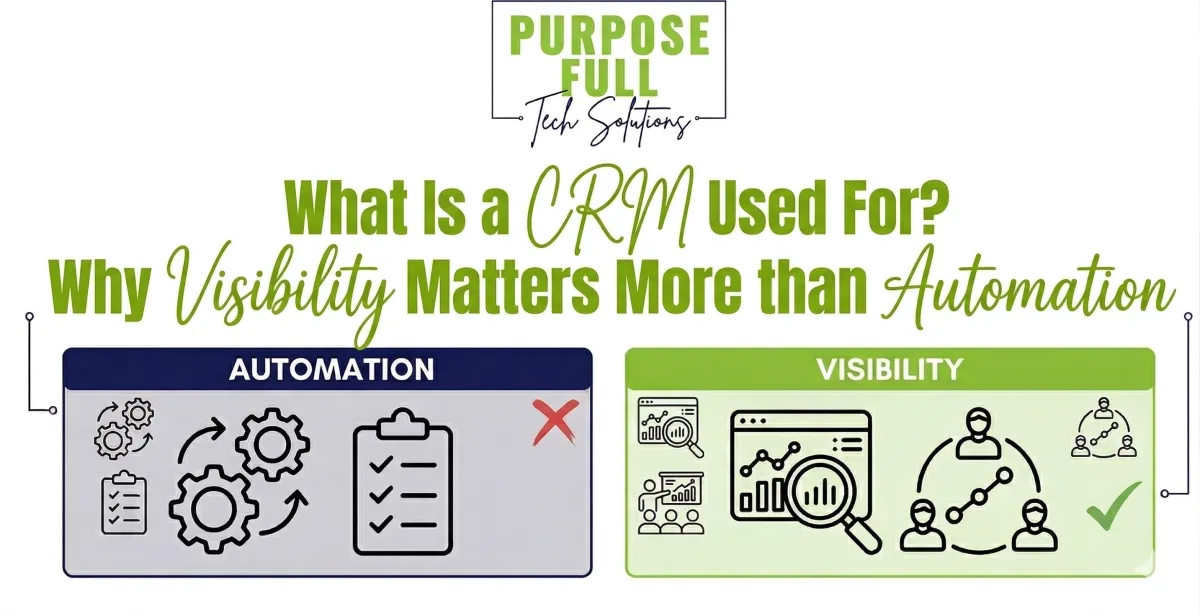
What is a CRM Used For? Why Visibility Matters More than Automation
Most conversations about CRM systems focus on features: Automation. Dashboards. Integrations. Reporting. AI. All of those things sound powerful, and they can be. But for most small businesses, they are not where the real value comes from.
So what is a CRM used for, really? The answer is much simpler than most people expect. The real value of a CRM is visibility.
If your CRM cannot clearly show you who needs attention, what is happening, and what comes next, then none of the advanced features matter.
Why Automation Does Not Equal Clarity
Many business owners assume that automation is the key to making a CRM work.
If follow-ups are inconsistent, automate reminders. If reporting is unclear, build dashboards. If communication is scattered, sync everything. But automation only works when the underlying system is already clear. If your stages are inconsistent, automation reinforces confusion. If your data is incomplete, dashboards reflect bad information. If your team is not aligned, automation creates noise instead of clarity.
Automation is a multiplier.
If your CRM system is strong, automation makes it better. If your CRM is unclear, automation makes it harder to manage. This is why many businesses invest in advanced features and still feel stuck. They are solving the wrong problem.
The Two CRM Metrics That Actually Matter
When you strip a CRM down to its most useful form, two pieces of information stand out above everything else.
When was the last time someone interacted with this contact?
When is the next time someone should follow up?
These two data points drive nearly every meaningful action in a sales process.
If you can answer them quickly and confidently, your CRM is doing its job. If you cannot, the system is missing its purpose. The last interaction tells you how active the relationship is. The next interaction tells you what needs to happen.
Without both, you are guessing. With both, priorities become obvious.
CRM Best Practices: Follow-Up Discipline Over Features
Many small businesses struggle with follow-up, but they try to solve it with tools instead of habits.
They look for ways to automate reminders or create more complex workflows. While those can help, they do not replace consistency.
A CRM works best when every active contact has a clear next step. Not eventually. Not when someone remembers. Immediately after each interaction.
My golden rule is that EVERY active lead/opportunity and EVERY active client MUST have either an appointment scheduled or follow up task. The task can be for 3 months from now, but you MUST have something scheduled.
This creates a simple rhythm:
You reach out.
You record what happened.
You decide what happens next.
You schedule it.
Over time, this becomes second nature. The CRM stops feeling like extra work and starts supporting your process. Without this discipline, even the best CRM system becomes reactive. Things fall through the cracks not because the software failed, but because the process was never followed.
How a CRM Improves Team Visibility
One of the biggest benefits of using a CRM effectively is how it improves (and reduces) team communication.
When visibility is high, teams spend less time asking for updates and more time taking action. Instead of asking, “What is going on with this account?” Someone can open the CRM and see the latest activity. They can see what was said, what was promised, and what is scheduled next. This reduces interruptions (hello, all of the back-and-forth emails and texts!), prevents duplicated effort, and avoids conflicting communication. It also builds trust. When everyone can see the same information, decisions become faster and more confident.
Balancing CRM Visibility and Privacy
As visibility increases, an important question comes up.
How much should everyone be able to see? On one hand, transparency helps teams stay aligned. On the other hand, not every conversation or piece of information should be visible to everyone. A well-designed CRM balances openness with control. It allows teams to collaborate effectively while protecting sensitive information. It ensures that the right people have access to the right data without exposing everything by default.
This is not just a system decision. It is a business decision. Teams need to agree on what belongs in the CRM, what should remain private, and how information should be shared responsibly.
When a CRM Starts to Feel Useful
A CRM becomes valuable when it answers one simple question without effort:
What should I do next?
If someone can open the system and immediately see who needs attention today, the CRM is working. If they can trust that the information is current and accurate, the CRM becomes part of how they operate. This is where most businesses finally start to see results. The CRM stops feeling like something they have to maintain. It starts helping them stay organized, follow through, and make better decisions. That shift does not come from adding more features.
It comes from focusing on visibility first.
A Better Way to Evaluate Your CRM
If you want to know whether your CRM is working, ignore the feature list for a moment. Instead, ask:
Can you quickly see which relationships are active and which are going cold?
Can your team tell who needs follow-up today without asking around?
Can you trust that what you are seeing reflects reality?
If the answer is no, the issue is not a lack of features. It is a lack of visibility. When visibility improves, everything else becomes easier. Follow-up becomes consistent. Reporting becomes meaningful. Conversations become more productive.
That is the real return on a CRM.
Not complexity. Not automation.
Clarity.
If your CRM isn’t giving you this level of clarity, it’s not a tool problem. It’s a design problem. Fixing that changes everything. Book a 15-minute consultation with me here.